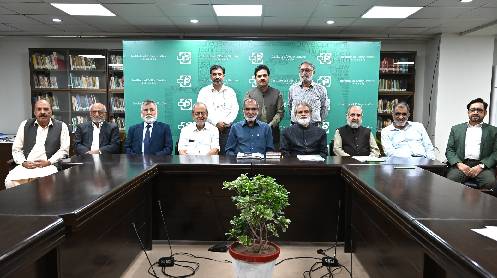
ISLAMABAD: Pakistan needs stronger institutions, better governance, evidence-based policymaking and effective implementation to address its complex national and international challenges, participants at the annual meeting of the National Advisory Council (NAC) of the Institute of Policy Studies (IPS) said.
Thank you for reading this post, don't forget to subscribe!The forum brought together scholars, policymakers, diplomats, technocrats and practitioners who called for forward-looking, practical and actionable approaches to Pakistan’s emerging challenges and opportunities in areas including technology, agriculture, maritime affairs, regional connectivity, security and socio-economic development.
The meeting was chaired by Khalid Rahman, Chairman IPS, and moderated by Ambassador (r) Syed Abrar Hussain, Vice Chairman IPS. The discussions also provided intellectual input for shaping the institute’s future research agenda.
The session opened with an assessment of the major transformations in the post-9/11 global order and Pakistan’s continuing governance, economic, climate and security challenges.
On governance, participants maintained that administrative restructuring alone, including the creation of new provinces, would not resolve the country’s problems. They stressed bringing governance closer to citizens, strengthening local and metropolitan institutions, reducing political interference and ensuring transparent decision-making and efficient public service delivery. The concept of charter cities was also discussed as a possible response to rapid urbanisation, subject to appropriate institutional arrangements and political commitment.
Agriculture, food security and nutrition were identified as critical areas requiring urgent policy attention. Participants highlighted Pakistan’s dependence on imports, particularly edible oil, and called for better water and irrigation management, improved crop planning, stronger farmer support, regulation of agricultural inputs, action against smuggling and more efficient agricultural value chains.
The forum also proposed measures to improve nutrition and food security, including biofortification, food fortification, kitchen gardening, school feeding programmes and stronger food standards, along with coordinated action among relevant institutions.
Discussing IT and artificial intelligence, participants called for a coherent national AI roadmap, stronger data architecture, interoperable digital public infrastructure, affordable computing facilities and the development of indigenous language and domain-specific AI capabilities. They also stressed the need for practical and locally relevant ethical frameworks for AI.
Pakistan’s maritime potential and its strategic and economic importance also came under discussion. Participants noted the limited role of domestic shipping and called for strengthening national and private-sector shipping capacity. They urged progress on Maritime Task Force recommendations, greater institutional accountability and a renewed national shipping policy.
On foreign policy and strategic affairs, participants emphasised the need to move beyond policy formulation towards practical, costed and measurable implementation. They highlighted the changing global order and called for balanced relations with major powers, while strengthening engagement with the Middle East, Central Asia and Afghanistan and making greater use of Pakistan’s regional and maritime potential.
Education was another key area of concern. Participants called for greater consultation, decentralisation and institutional cooperation, while cautioning against excessive centralisation and unnecessary institutional interference.
The forum also examined challenges facing the family institution, including changing social conditions, rising family disputes, generational gaps, migration and evolving expectations. Participants advocated stronger research, parenting programmes, marital counselling, greater youth and women’s engagement and family-sensitive legislation.
The participants further called for policy and intellectual approaches rooted in Pakistan’s own cultural and intellectual context, arguing for greater engagement with Islamic thought rather than relying excessively on inherited colonial and Eurocentric frameworks. Islamic banking was also discussed, with participants stressing the need to move beyond formal interest-free arrangements towards broader social and economic objectives.
The meeting concluded with a consensus that Pakistan’s future success would depend on its ability to anticipate emerging trends, strengthen institutional capacity and translate knowledge and research into practical, measurable and sustainable solutions.